Personalized attention +34 96 206 62 98
 Free shipping to Iberian Peninsula from 30€
 9/10 Rating
 Discreet shipping


Removing big leaves from marijuana plants is something that many growers tend to do, especially beginners. This practice has both defenders and detractors, and that’s why we’ve provided this article with all the necessary information on removing big leaves from marijuana plants.
What are the big marijuana leaves for?
Marijuana leaves serve essential functions for the plant, which is why they are produced. Among the various roles that cannabis leaves have, they include:
- First and foremost, they serve for respiration, promoting healthy plant growth.
- They also aid in the storage of minerals and other essential elements the plant needs, such as water.
- Marijuana leaves are responsible for conducting photosynthesis, allowing all these elements to be transformed into energy. This enables the absorption of sunlight or light from a lamp and its conversion into sugars or chemical energy for further growth at full capacity.
All of this enhances the development of the root system, the formation of branches and leaves, which ultimately contribute to the plant’s growth and increased yield.
Removing big leaves from marijuana plants
The importance of marijuana leaves lies in their presence throughout the plant’s life cycle. A specimen without leaves will be a weak plant with minimal production and a sickly appearance.
Therefore, if we prune out plants, they may not acquire enough energy to continue growing, and their growth may stop, or they could even die if we remove too many leaves.

Plants naturally contain a high percentage of their weight in water, mainly stored in the leaves. The underside or lower part of the leaf holds microdroplets of water that help cool the CO2 or oxygen they absorb when it’s very hot.
Removing cannabis leaves from the plant exposes certain protected areas to light, affecting the heat within the cultivation. Additionally, in stressful situations like droughts, these plants will quickly deplete their reserves, as leaves also function as nutrient stores. They will use these reserves in emergencies, depleting them until the leaves turn completely yellow.
When and how to remove big leaves from marijuana plants
Marijuana eaves, whether small or large, should not be removed while the plant is alive, except in specific cases. Some instances in which it may be necessary to remove them are:
Pest infestations
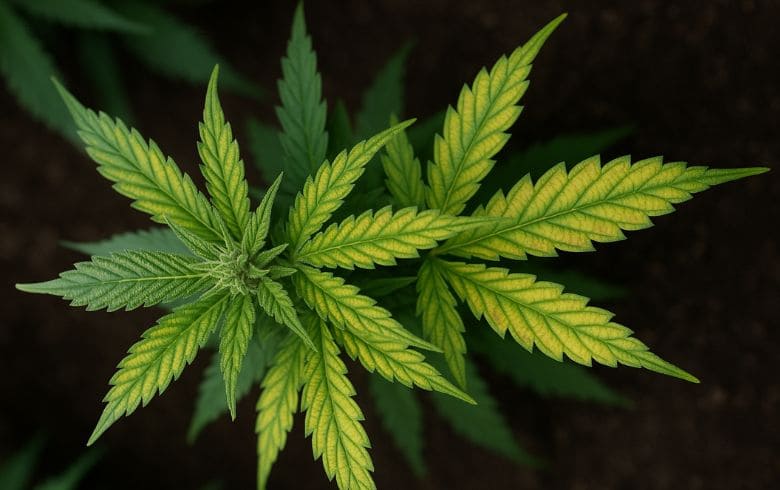
We can remove them when there is a problem caused by fungi or pests, you will notice it because of the cananbis leaf syntoms. To save the plant, certain steps, including pruning the leaves on marijuana plants, should be followed. However, this should be a last resort after trying other techniques.
In the case of pests, some of them, like red spider mites, can rapidly multiply their population and infest a crop in a very short time. These insects lay their eggs on the undersides of marijuana leaves, making it necessary to eliminate these leaves in many situations to get rid of the infestation.
- If the issue is with fungi, such as powdery mildew, leaf pruning may be necessary. If not detected in time, it will spread throughout the foliage until it turns completely white. In such cases, the only option may be to apply a specific insecticide to control the infestation.
- If that doesn’t work, it will be necessary to remove the most affected leaves, leaving only those that are healthy.
Bud growth
Sometimes, there is a desire to increase the size of the buds on the lower part of the plant. To allow more light to reach them, large leaves are removed a week or two before harvest. This not only provides more light but also improves airflow, reducing the risk of fungal issues.
Bushy plants

In very bushy genetic strains, it’s important to ensure there is adequate spacing between the branches for light and air to penetrate. If there is sufficient spacing, simply guiding the leaves or branches should suffice.
When pruning leaves, it’s important to select those that obstruct the lower branches. This defoliation should be done during the flowering stage to enhance development and yield.
It’s worth noting that as the plant progresses through its cycle and some leaves remain in shadow, the plant naturally absorbs the nutrients it needs from these leaves, causing them to dry up and fall off on their own.
Towards the end of the flowering stage, the plant tends to be so lush that many of the older leaves are no longer needed, causing them to fall or turn yellow.
Removing big leaves from marijuana plants can provide benefits if done correctly, but it should be approached with care to avoid potential setbacks.