Personalized attention +34 96 206 62 98
 Free shipping to Iberian Peninsula from 30€
 9/10 Rating
 Discreet shipping


Cannabis seedlings represent the most delicate and sensitive phase of the entire growing cycle. During these first days, even the smallest mistake—no matter how insignificant it may seem—can affect their future development. This is why it is essential to understand how they function, what they specifically need, and how to safely support them until they are ready to grow vigorously.
This guide offers a clear and straightforward explanation designed so that anyone can properly care for their Cannabis Seedlings during their first weeks of life.
What is considered a newly sprouted cannabis plant?
A newly sprouted cannabis plant is one that has just emerged from the substrate after germination and displays its first two rounded leaves, known as cotyledons. This stage typically lasts between one and two weeks depending on genetics and environmental conditions. During this time, the plant develops a thin and flexible stem, two cotyledons that act as initial nutrient reserves, and within a few days, the first set of serrated “true leaves.” The root system also begins to expand, although it remains delicate and extremely sensitive to excess moisture and lack of oxygen.
At this point, the plant depends entirely on its environment. It is a crucial stage that determines how the plant’s structure will develop—whether it will form a strong stem, a healthy root system, and a balanced growth rhythm.

Ideal conditions for healthy cannabis seedlings
When caring for Cannabis Seedlings, the most important factor is maintaining a stable environment to prevent any type of stress.
Temperature should ideally remain between 22 and 25 ºC (71–77 °F). Below 20 ºC (68 °F), metabolic activity slows down, while temperatures above 27 ºC (80.6 °F) may lead to rapid dehydration.
Humidity also plays an essential role: the ideal range is between 65% and 75%. At this level, the plant retains moisture effectively without oversaturating the substrate. However, excessive humidity can lead to fungal issues that affect the stem and the plant’s base.
Ventilation should be gentle. Seedlings do not tolerate strong drafts, but they do require proper air exchange to avoid stagnant air. Ideally, the airflow should move the leaves very slightly—just enough to strengthen the stem without stressing it.
Growing Parameters by Plant Stage
| Cannabis Seedlings | 22–25 ºC | 65–75 % | Soft, 18/6 | Light and frequent | Light, well-aerated |
|---|---|---|---|---|---|
| Vegetative Growth | 20–26 ºC | 50–60 % | High, 18/6 | More abundant | More enriched |
| Pre-flowering (Stretch) | 20–26 ºC | 45–55 % | High, 12/12 | Regular and controlled | Stable, good drainage |
| Early Flowering | 20–25 ºC | 40–50 % | High, 12/12 | More abundant than veg | Fertile, rich in PK |
| Late Flowering / Bud Fattening | 18–24 ºC | 35–45 % | High, 12/12 | Less frequent watering | Rich in PK, stable |
| Final Stage / Root Flush | 18–24 ºC | 35–45 % | High, 12/12 | Water only, moderate | Substrate free of salt buildup |
Proper lighting for cannabis seedlings
Many beginners assume that more light always means better growth, but during this stage that is not the case. Cannabis Seedlings require soft, stable, and controlled lighting. A dimmable LED fixture or a low-intensity CFL is usually sufficient. Light intensity should not be too high—starting at 40–50% power or placing the lamp 40–60 cm away (depending on the light type) is recommended.
If the light is too close, you may see light burn or excessively compact growth. If it is too far, the stem may stretch excessively, becoming thin and weak—a condition known as stretching. The ideal photoperiod for this stage is 18 hours of light and 6 hours of darkness. Although it may seem like seedlings need continuous light, darkness plays a vital role, allowing them to organize energy and strengthen tissues.
Watering: The most common source of errors
Watering is likely the area where most growers struggle. Cannabis Seedlings need very little water, but they require it regularly and evenly distributed. The goal is to keep the top layer of substrate slightly moist without saturating it. Since the stem is extremely thin, any excess moisture encourages fungi such as damping off, which softens the stem base and causes the plant to fall over.
The best way to water Cannabis Seedlings is to apply small amounts of water around the stem, moistening only the upper layer of the soil. Watering should occur when the top of the substrate begins to dry slightly. Water quality also matters—low mineralization water with a pH between 5.8 and 6.2 and very low EC (below 0.4) is ideal. Young roots do not tolerate salts well.
Fertilizers at this stage? Less is more
Most commercial substrates already contain the nutrients required for the first weeks of growth, so Cannabis Seedlings generally do not need fertilizer during this period. Adding nutrients too early can cause root burn or nutrient lockout, resulting in deformed or yellowing leaves.
Once the plant develops three or four pairs of true leaves, you may begin introducing a mild growth fertilizer. Alternatively, you can use a root stimulator in very low doses, although it is not essential. The key is to avoid saturating the substrate, as this only stresses the plants.
Appropriate substrate and pots
The substrate should be light, aerated, and offer good moisture retention. A mix of peat, coco, and perlite works very well, providing excellent oxygenation and allowing the root system to expand freely. Other substrates may be used, but the issue with compact mixes is that they hold too much water and restrict oxygen flow.
As for the pot, it is best to start with a small container between 0.25 and 0.5 liters. A pot that is too large retains excessive water, preventing the plant from finding the balance it needs to grow. When the roots have colonized most of the available space and several pairs of leaves have formed, it is the ideal moment to transplant into a larger pot.
[ppgbo products=”5090,7173,2696″ language=”en”]
Common problems in cannabis seedlings and how to fix them
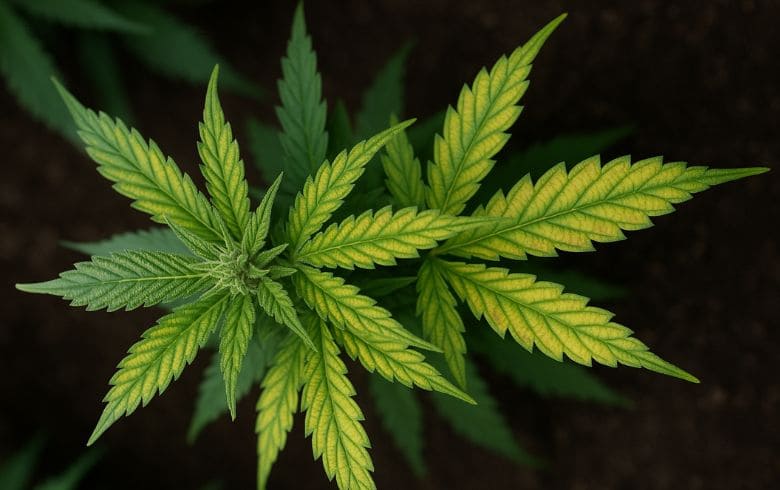
One of the most common issues in Cannabis Seedlings is stretching. This happens when lighting is insufficient or positioned too far away. To fix this, simply lower the lamp or slightly increase intensity. Another frequent symptom is yellowing cotyledons, which often indicate overwatering or a substrate that is too nutrient-rich. Reducing water and using a lighter substrate usually resolves the issue.
Damping off is perhaps the most feared problem: the stem base weakens until the plant collapses. The primary cause is excessive moisture combined with poor ventilation. To prevent it, ensure the substrate can breathe, water moderately, and maintain gentle constant airflow.
How to strengthen your cannabis seedlings
Once Cannabis Seedlings overcome the first few days and show stable growth, you can begin strengthening their structure. A light breeze from a small fan helps thicken the stem, making it more resilient. Light intensity can also be gradually increased—about 10–15% per week—allowing the plant to adapt without stress.
Transplanting is another key step. When roots begin to protrude from drainage holes or the pot becomes too small, moving the plant to a larger container gives it the space needed for continuous development.

Final tips for healthy growth
The key to caring for your plants ultimately comes down to observation. Seedlings change quickly, offering daily clues about their well-being. It is advisable to keep the grow area clean, avoid touching plants unnecessarily, and track germination dates for more accurate monitoring. With proper environmental control and small daily adjustments, Cannabis Seedlings rapidly transform from fragile sprouts into strong young plants.
Cannabis Seedlings need gentleness, stability, and a well-controlled environment. Their initial fragility should not intimidate you: with soft lighting, moderate watering, proper humidity, and an aerated substrate, they will become strong plants ready for vigorous growth in just a few days.
Caring for this stage is the best investment to achieve a high-quality, abundant harvest.